
What Starmer cannot say
The hypocrisy, in so many directions, the Epstein files reveal of the Westminster and the media class

Orwell wrote that hypocrisy was the defining characteristic of English national life — that it was “world-famed”. In an era when we have few world-class industries left, one of the few consolations of this week has been the reminder that we still lead the world in something. Over five days in which Keir Starmer has been rightly forced to reflect hard on his own decisions, there has been almost none of the same from the rest of the Westminster universe — where even now the real truth remains largely unsaid. What this week has revealed is how institutions, especially the press, retroactively discover outrage once the costs of outrage have fallen.
The mood of the Parliamentary Labour Party is genuinely sulphurous. Starmer entered this crisis with his political credit close to exhausted. There have been too many unforced errors, too many futile debacles MPs have been forced to defend. This is the gravest example yet. His position is fragile. The documents and communications that must now be published as a matter of law may prove deeply embarrassing, or worse. If they show that the Prime Minister has misled, he will be finished.
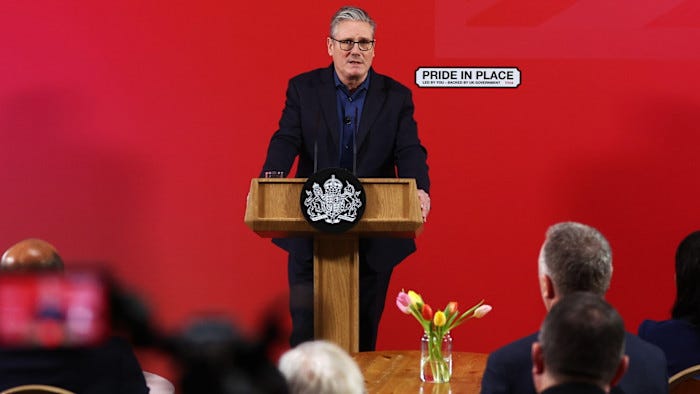
But for a moment, let us take Starmer at his word. Let us imagine that his gravest sins were credulity and poor judgment. Even that, given the back catalogue of mistakes, might be sufficient to warrant his removal. But taken on its own terms, is it fair?
The moment of rapture appeared to come at Prime Minister’s Questions, when Starmer confirmed — on the third time of asking — that he had known Peter Mandelson continued his friendship with Jeffrey Epstein after Epstein’s conviction for soliciting sex with a minor. This horrified Labour MPs. There was something about a Labour leader saying it aloud at the dispatch box that blackened the air and stiffened resolve. How could it have come to this? I understand the weight of that moment. It is ugly. But if this truly was the moment of no return, it embodies one of the darker truths of the affair: Starmer was not the only one who looked away. Because this fact was widely known, albeit not to the lurid extent the files now show.
The question which reveals this hypocrisy is a simple one: why was Starmer in early 2025 able to appoint Mandelson in the first place? If the fact of Mandelson’s friendship was considered as egregious as it is now, he would never have been considered. Indeed, take a look at the ways in which it was written up, at the time, by many of those most outraged after the fact. When the appointment was announced, did the papers focus on the Epstein link? No, nearly all of the reaction was about China. Take The Times, or The Guardian or The Telegraph, none mention Epstein once in their copy. Instead their focus is the potential MAGA backlash to his links in Beijing in Brussels. GBNews, who have been bloviating loudest as usual, did take a different tack, instead complaining that Nigel Farage had been cruelly overlooked (Farage himself welcomed Mandelson’s appointment). In other words, in January 2025, Epstein was barely mentioned by the press or parliament.
There were exceptions, most notably the Financial Times, which pursued the story doggedly. But as all journalists with big stories will tell you — myself included — it is an irritating fact of life that such stories are often ignored by other newsrooms. Starmer, of course, had better knowledge than we did, and the FT were unrelenting in trying to warn him. He also had a higher duty than writing a headline. But the relative acquiescence at the time matters. It is part of the context in which the decision was made.
I include myself in that acquiescence. In November 2024 I interviewed Mandelson in Oxford, where he was standing for election as Chancellor of the University. At the time, this did not seem extraordinary, as it does now. On a crisp late-autumn morning, I spoke to him amid a bevvy of enthusiastic student supporters. He is undeniably an astute reader of politics and an interesting interviewee. There was much to press him on — China, Trump, Starmer’s government — and there were headlines, as expected. I had considered, with my producer, asking about the FT’s reporting on Epstein.
In the end, I did not. Not because we were friends — I don’t really make friends with politicians, and I’d met Mandelson only a handful of times, always professionally — but because of a familiar set of calculations. I thought he would refuse to engage or walk out, and the interview/episode lost; that he might threaten legal action we could not substantiate with the same effect; that he was likely to become ambassador and would be more journalistically valuable to interview later; that the very certainty of that appointment made the allegations seem more outlandish; and, bluntly, that these stories were low on the news agenda.
Does this reveal a rotten journalistic system? I don’t think so. I did not fail to ask because of fear of social loss. But I was wrong in making that judgment, as were many others, partly arising from the incentives, rhythms and psychology of news which made the risk feel irrational at the time. These daily calculations are made all the time. I have reflected on that a great deal over the past few days, and I take it on the chin that I made a mistake. I should have seen that even the suggestion of what we now know to be true mattered more than any of those considerations — and that the victims deserved the question.
I recount this not because the decision was especially important, but because it reveals something I cannot ignore but which many are: how distant the Epstein story felt then. That makes it harder for me to judge Starmer — unless he knew something I did not. Like me, he made the wrong judgment in light of what we now know. But I also know this: if those now shouting loudest had been shouting then, the question would have been harder to avoid — and the appointment less likely to be made. Because of this episode reveals anything it is the power of the old media to dictate the terms.
None of this is intended to excuse Starmer. Labour MPs were right about one thing: he was visibly strangulated at the dispatch box. His hand trembled. He seemed to shrink as the minutes passed. Perhaps it will yet emerge that he was hiding something — something he knows, deep in his lawyer’s bones, will destroy him. A Prime Minister of probity ejected from Downing Street in the worst ethics scandal since the last one.
But perhaps it was something else. Deep down, in those same lawyer’s bones, he knows and we know, the real reason he appointed Mandelson, another truth from which we still look away: he appointed him not in spite of his relationship with Epstein, but because of his relationship with Epstein.
That does not mean Starmer regarded it as an asset. But it did signify something: Mandelson’s ease in the world of the wealthy and the lawless, the lurid and the powerful, the beautiful and the damned. He was at home among global elites for whom scandal is survivable. In other words, he would be entirely at home in the court of Trump. Many of the same columnists now condemning Starmer praised him at the time for appointing a “master of the dark arts”, for taking a gamble. Starmer was no natural admirer of Mandelson, but came to believe that the jeopardy of the US-UK relationship under Trump justified the risk.
If you want the counterfactual proof positive of that, consider another alternative reality: one where Kamala Harris had won the 2024 presidential election. Mandelson’s name wouldn’t have even been on the list. In other words, Mandelson was a reflection of the mores legitimised by the Trump era. Another man about whom much is known, and even more is ignored. Starmer held his nose because he thought the geopolitical gain was worth it, another ugly calculation of risk.
What has been largely absent from the fury this week is the anger that matters most. For the women and girls abused by Epstein and men like him, there was no sudden revelation, no shock. Only the long, familiar experience of not being believed, not being prioritised, not being worth the inconvenience. It is not that we did not know. It is that, once again, we did not think it urgent — until the files overall made indifference impossible, until the accumulated record of what was known, ignored and tolerated could no longer be waved away.
Starmer will have to reckon with that. But so should we all.
P.S. I talked more about this on today’s News Agents. It can be heard here.
If Starmer is the man who faces consequences over the Epstein files and not the actual ones in the files I give up. How utterly ridiculous. None of this pantomime has anything at all to do with the victims.
Super refreshing take on the elephant in the room: Mandelson was allowed to be a regular panelist on the Time's politics podcast, among many other, similarly high-peofile gigs. Nobody bat eyelid then.
The one thing this saga has made be ponder though is whether I should read the FT more often.