
Why Rejoin Cannot Be Labour’s Answer
Andy Burnham and the Politics of Control

It is possible to think two things at the same time. Brexit was a political and economic disaster for Britain. It was a project predicated on a world of ever freer trade, geopolitical tranquility and a cordial United States. In every respect, we now live in its mirror. The threadbare Brexit settlement, negotiated in the dead of night by the feckless Johnson government has left us more economically distant from our European partners than even Turkey or Iceland. The trade and regulatory barriers enacted continue to be onerous for business. The freedom for the individual has lessened and the scope of the bureaucrat enhanced. However much the right-wing British press might ignore it, it is a slow motion economic crisis.
It is also possible to think that in political and policy terms, now is not the time for Labour to reopen this Pandora’s Box.
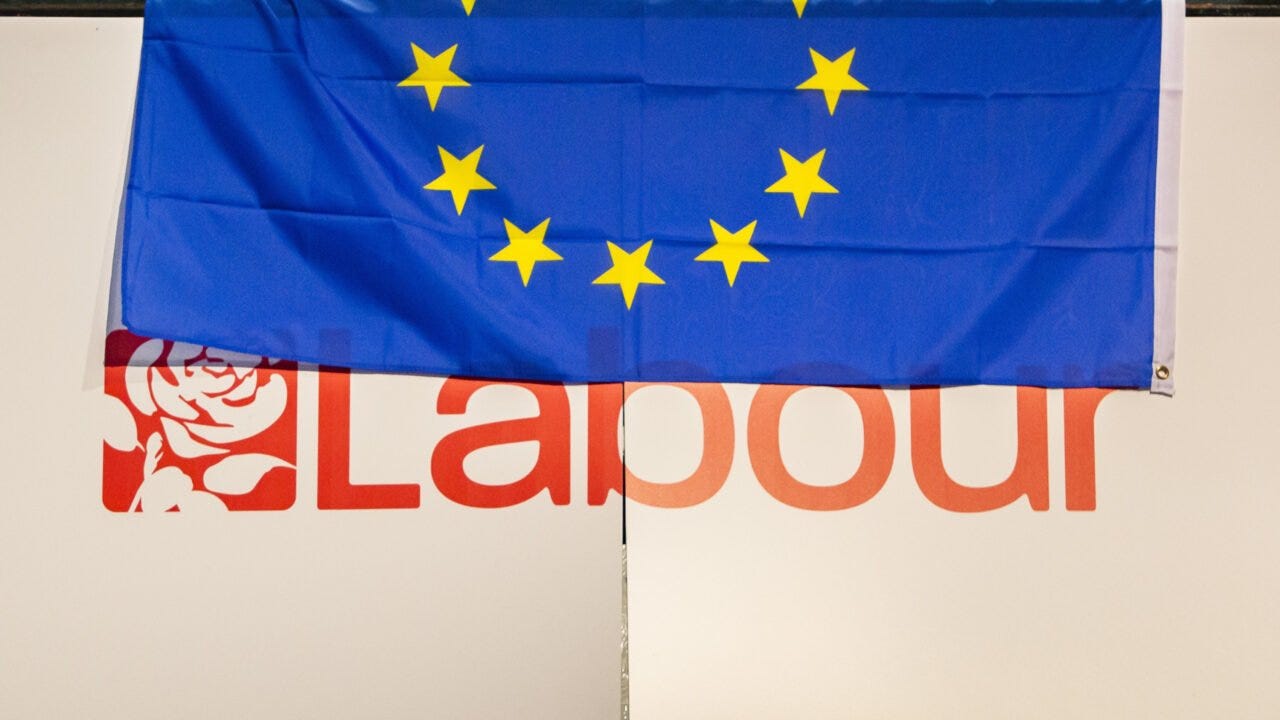
When Wes Streeting says he’d like to Rejoin (in fairness not now, but one day), he is right to make an argument, in vivid terms. He’s right to say that Keir Starmer’s great problem is that he too often has been unable to unwilling to do the same. Streeting is right too that the fear of criticising Brexit has allowed Nigel Farage to escape scrutiny over his signature contribution to British political life. Labour should loudly and without restraint, slam its authors for the false prospectus they sold the country, for the fact its benefits have not materialised, and could never have done in the way they said.
But in narrower political terms, this is a far less noble cause. Streeting’s sudden rendition of Ode to Joy is not about a future electoral contest but the one in Makerfield. He has an eye on a leadership contest which takes place in the fear, loathing and confusion of a Burnham loss. He is attempting to win the membership in the way that Keir Starmer did in the years before 2020: by being seen as the most pro-EU voice on the Labour benches.
There is a long term argument for Labour to make. It will take a decade, bit by bit, inch by inch. But as Lynton Crosby famously said: you can’t fatten a pig on market day. Labour just hasn’t been talking about this with any intensity for too long. It cannot rely on Brexit now, a break glass in case of emergency policy, to try and win back disaffected liberals, indeed it would be deeply counter-productive. For Labour to start talking about rejoining, in the raw politics of a moment where the party has literally been displaced across much of its old heartlands by a force led by Farage, and until recently called the Brexit Party, would feel, how can I put it- deeply Jo Swinson.
And it isn’t just the raw politics. My fear is that Rejoin becomes for the progressive left what Leave was for the radical right: a place-card for thought, the all-purpose medicine to our ills. The economic growth which would be generated by rejoining would be welcome and could be put to productive and just causes. But it would not be a panacea. At best we would be returning to the status quo ante of 2016, a settlement which was so unsatisfactory, to so many people- including core Labour voters- that Brexit itself was born. The desire for Brexit, a yearning for deep political, social and economic change, for which the electorate keep voting, has to be reckoned with and it does not require rejoining to achieve. For reasons I’ve written about before, the lack of true intellectual engagement on the left with that yearning, has been embarrassingly slight. Labour would be better off for the next decade focussing on a transformative domestic economic programme. Whisper it- some of the powers of Brexit- on industrial policy and regulation, will be useful for that endeavour.
The truth is that the decade of Brexit has been bad for us, but it’s been bad for the EU too. Without the British at the table, the EU has become more protectionist, more heavily regulated, less economically competitive. It has a desperately poor record on emergent technologies, sometimes heavily regulating industries before they even exist. By its own admission, it is hurtling fast towards being a museum continent. There aren’t many opportunities from Brexit, but the regulatory freedom over these new industries is one of them and should be leveraged mercilessly by a British government, along with the ability to craft a more ruthless industrial policy.
What Burnham has, which Starmer never did, is a theory and critique of power. In some senses, it is a deeply liberal one. That social, political and economic power is hoarded zealously by those with vested interests. He wants to redistribute it, from Westminster, from monopoly industries, from elites. Right now, he is more like a US Governor, going to Washington as President Elect, promising to clean up town- almost a novelty in our political history. He is currently a sectional politician, Mr Manchester, looking to retranslation to a national one, a project which will not be easy when he becomes the centre. One way in which he can do it is by remaining relentlessly anti-Westminster, as is the country, running against it from within, as Trump has done. He can use the powers he has to break up the water companies, the power companies, the natural monopolies- to threaten compulsory nationalisation if necessary, something which would be harder with EU membership. Poisonous to the idea of his being an insurgent outsider, would be to take power from Westminster only to hand it to Brussels, landing him back squarely with the old order.
That is the real danger for Labour. We see again and again, from Brexit on, that the electorate is voting against distance, against managerialism, against the sense that power is exercised somewhere else, by someone else, for somebody else. Burnham understands this in a way much of Labour still does not. Millions of voters came to see the ancien régime not as a guarantor of stability, but as the very cause of decline. They still do. The next political era will belong not to the politician who promises to take Britain back, but to the one who convinces voters they can finally take control.
is entirely possible to hold two thoughts in your head at the same time.
Brexit was a political and economic catastrophe for Britain — a project built for a world of frictionless global trade, geopolitical stability, and dependable Atlanticism. Instead, we now inhabit its inverse: protectionism, fragmentation, strategic insecurity, and an increasingly erratic United States.
The skeletal Brexit settlement cobbled together by the intellectually vacant Johnson government left Britain more economically estranged from Europe than countries like Turkey or Iceland. Trade friction increased. Regulatory burdens multiplied. Freedom of movement vanished for ordinary citizens while bureaucracy expanded for everyone else. Beneath the forced optimism of the British right-wing press lies a slow, grinding national decline.
But it is also possible to understand why Labour fears reopening the issue politically.
The problem is that “now is not the time” has become the permanent excuse of timid politics. There is always another election, another crisis, another focus group, another warning not to upset the ghosts of 2016.
If Brexit is genuinely damaging the country — economically, strategically, culturally — then there is no magical future moment when repairing it becomes easier. Leadership is not waiting for perfect conditions. It is recognising a mistake and correcting it before the damage deepens further.
There is rarely a convenient time to do the right thing.
Two things can indeed be true at the same time.
Setting a direction of travel and concrete steps to returning to the Single Market and - eventually - the EU; AND - at the same time - setting out tangible policies on cutting the cost of living is the best strategy IMO.
Labour badly needs to shore up its left flank and the best way of doing that is bold policies on the EU, renewable energy, constitutional reform etc.
Consolidate your liberal base before picking off the Reform curious floating voters with a clear policy vision is the only way forward to my mind.
Not clear to me that Burnham understands that; he was cleverly outflanked by Streeting. That's politics.
By demurring on the EU question - which was never put to bed - Burnham currently seems to be offering Starmer 2.0.